Wortalleth West’s concealed surveillance system
Panic RoomWortalleth West’s concealed surveillance system is a network of hidden cameras and recording equipment that makes the house’s ordinary rooms, movements, and absences visible from a secret room behind a mirror. It establishes an unsettling asymmetry: Don Challenor and Blake can be watched without knowing it, while the invisible centre from which the watching takes place remains beyond the system’s view. The house appears to contain its own observer, but that observer is concealed within the place being observed.
Hidden Architecture
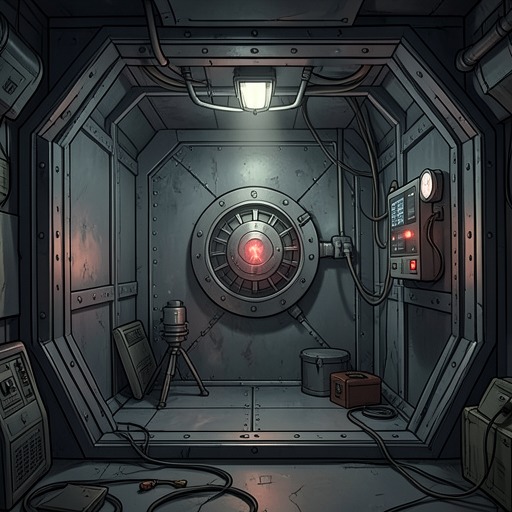
The surveillance room is dark, though not unlit. Stand-by amber glows on offline computers; red digital clocks mark seven time zones—London, Frankfurt, Moscow, Beijing, Tokyo, Los Angeles, and New York—and a bank of video screens flickers grey and white. These details give the system a physical presence without making its operation fully transparent. The computers are described as offline, while the screens display camera feeds; the passage does not explain the technical relationship between them. Instead, it sets out what the concealed arrangement can show and leaves the machinery behind that view partly obscure.
The cameras are hidden in fittings and fixtures that belong to the house’s architecture: light fittings, cornices, and intrusion sensors. One camera is concealed inside the master-bedroom closet. Their placement makes surveillance difficult to distinguish from the ordinary fabric of the building. The system is not presented as a conspicuous apparatus that intruders might notice, but as a set of unobtrusive points from which the house can be observed. That concealment matters to its power: people moving through familiar rooms have no apparent reason to think that their actions are being recorded.
Coverage and Recording
The screens show Don approaching the mirror in the master bedroom’s closet and standing close to it for a minute or more before retreating. He then appears on another screen in the bedroom itself, and on a third Blake is visible in the kitchen, stirring porridge beside the hob. A further screen shows Don on the landing. The feeds thus follow people across different parts of the house, presenting a sequence of ordinary actions through separate camera views rather than through the characters’ own awareness of being watched.
Other screens show rooms in which nothing is moving: empty chairs and tables, stretches of hallway, a gym full of equipment, and a wine cellar lined with bottles. These inactive images widen the system’s reach beyond the moments when a person happens to cross a camera’s view. The rooms remain under observation even when apparently unoccupied. The contrast between Don and Blake in motion and the vacant interiors makes the house seem legible as both inhabited space and stored inventory: people come and go, while objects and rooms wait in view.
The narration makes the extent of the record explicit: minutes, hours, days, and weeks of comings and goings, along with the much longer absences from Wortalleth West, are captured. The system’s function is therefore not limited to showing a present instant. It accumulates a record across different scales of time, including patterns of presence and absence. The repeated declaration, "Everything is seen. Nothing is missed," gives that accumulation the force of an absolute claim. Yet the surrounding passage immediately qualifies it.
The Blind Spot and Its Significance
The cameras do not show what happens inside the surveillance room itself. That space is the house’s invisible centre, the secret heart of what Jack Harkness has built, and the place where the system’s provisions wait for their moment. The contrast is central to the object’s meaning: a network that seems to leave no movement unrecorded depends on a concealed location that escapes its own coverage. Its apparent completeness is produced by a carefully maintained omission.
This exception changes the force of the claim that nothing is missed. Within the watched rooms, the system gathers images and records extended patterns of use and absence; at its centre, the people and preparations behind the watching remain unobserved and unsuspected. Surveillance here is not simply a matter of seeing more. It is also a way to control who can see, and to protect the observer from becoming an object of the same scrutiny. The mirror and the hidden room sharpen that division: the house offers surfaces and rooms to view, while withholding the place from which those views are collected.
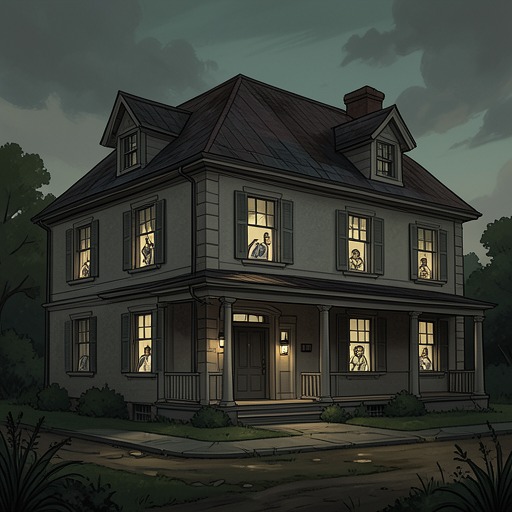
The revelation of the screens follows Don’s denial that there is anything at all, then shifts attention from the visible bungalow to what its architecture conceals. By showing the surveillance room and its feeds, the narrative turns an apparently ordinary domestic interior into evidence of a larger hidden arrangement. The system’s reach is concrete—bedroom, kitchen, landing, hallway, gym, cellar—but so is its limit. What is being prepared in the room behind the mirror remains unseen, and the screens’ final importance lies as much in that withheld interior as in everything they record.